27.5 C
Lagos
Saturday, March 14, 2026
Home Blog Page 110

‘National Thunder’ to strike Super Eagles

As Nzelang Nacional plots to clip Super Eagles’ wings


Nigeria and Equatorial Guinea officially kick off their TotalEnergies CAF Africa Cup of Nations Cote d’Ivoire 2023 campaign on Sunday afternoon in an exciting Group A encounter where the Nzelang Nacional (National Thunder) plots to clip the Super Eagles’ wings.


The meeting between the two sides promises to be an action-packed affair with relatively high stakes in a tough Group A consisting of hosts Cote d’Ivoire and Guinea-Bissau.


The Super Eagles were flawless in their group stages in the previous edition to be stunned by Tunisia in the knockout stages, who had qualified as the third-best team from the group stages.


Star-studded Nigeria has learned from their mistakes, and with the likes of CAF Player of the Year, Victor Osimhen, Samuel Chukueze, Ademola Lookman, and Kelechi Iheanacho on the side, Super Eagles will be looking at going all the way in their quest of winning a fourth African title.


Equatorial Guinea, which is also known by the moniker Los Elefantes (The Elephants), on the other hand, certainly are no pushovers.


They reached the quarter-finals during the last edition held in Cameroon, which included a shock 1-0 defeat over Algeria and Mali, who they knocked out in the round of 16 to advance to the quarter-finals.


The small Central African country that will be playing its fourth TotalEnergies CAF AFCON also made it to the quarter-finals in the 2012 edition.


Kick off at the Alassane Ouattara Olympic Stadium is at 14h00 GMT.


An Island’s hope rests on trio

0

Paris triumphs could illuminate Grenada’s centenary


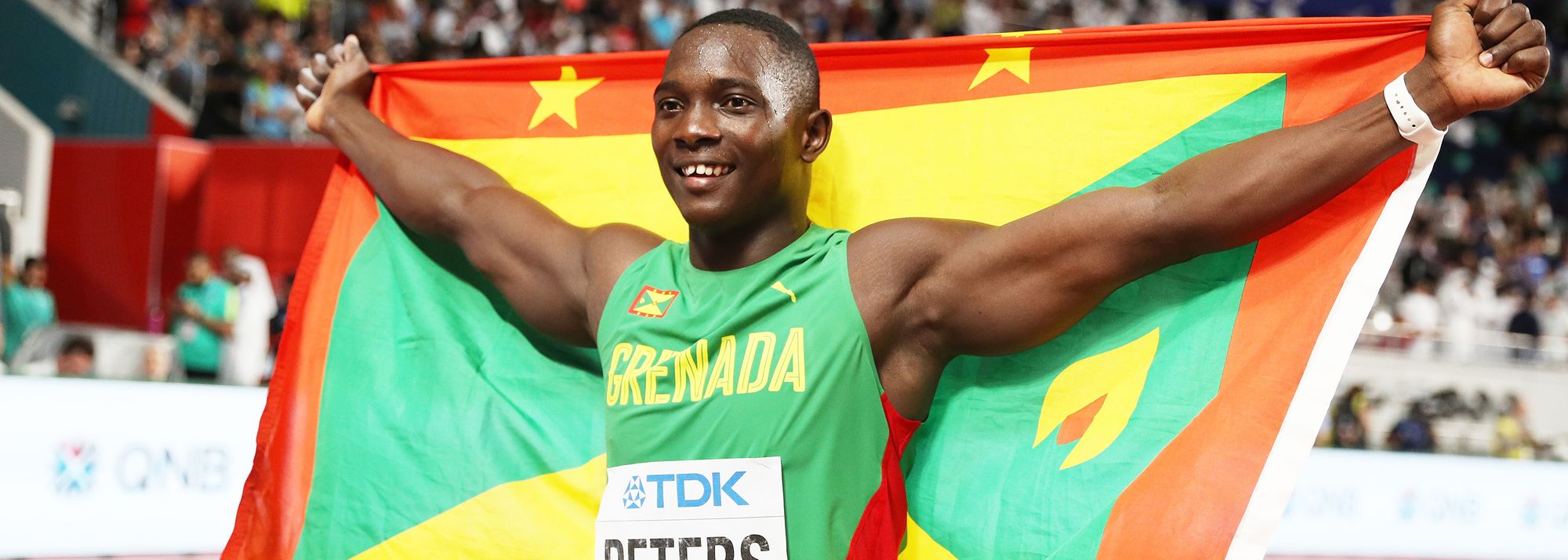
Anderson Peters celebrates his 2019 world javelin title win in Doha (© Getty Images


The Grenada Athletic Association celebrated its centenary earlier this week, with 11 January 1924 inscribed in the annals of World Athletics as the day the island’s federation was founded, Phil Minshull reports for World Athletics Heritage.


However, in the cricket-loving country of barely 124,000 people in which athletics always struggled for public attention until the ascent of global superstars and world champions like Alleyne Francique, Kirani James, and Anderson Peters, there was little fanfare and not a little déjà vu with the way the federation quietly came into being a century ago.


Alleyne Francique on the way to his world indoor 400m title in BudapestAlleyne Francique on the way to his world indoor 400m title in Budapest (© Getty Images)

The founding of the Grenadian federation took place against a backdrop of social and political change in what were then the British colonies in the Caribbean during the early 1920s; although this was mainly more representation for the local aristocracy in the colonial administrations and, as has been noted by various historians, unemployment and poverty were rampant.


However, as a corollary to these changes, many sports federations were also formed by the colonial leaders of the time, and it is no coincidence that the Grenada Football Association was also formed in 1924.


However, Grenada joining any major international federations was still decades away.


Athletics competitions allowing any talent to be identified were also severely limited for many years owing to poor facilities, including rudimentary grass tracks.


Gittens becomes Grenada’s first athletics hero


The first Grenadian athlete to make any impact internationally, albeit on a regional basis, was the multi-talented William ‘Pablo’ Gittens in the 1950s.


As noted by Renold O’Neal in his highly informative treatise on the history of athletics in the Organization of Eastern Caribbean States, which includes Grenada: “Gittens was an exceptional sportsman who also represented his county in cricket and football and in the latter sport just missed being chosen for the West Indies combined team that toured Great Britain in 1959.


“Gittens lived for a while in southern Trinidad and became a constant at the Texaco Southern Games, for many years the most important athletics competition for athletes from the British Caribbean.”


The versatile sportsman competed in these Games from 1953-58, and he twice won high jump and long jump doubles and, on another occasion, took the 400m hurdles crown.


At the British West Indies Championships – which existed from 1957-65 – Gittens also shone, and he won Grenada’s only medals: a 400m hurdles gold and high jump silver in 1958 and a 400m hurdles bronze in 1959.


Sadly, Grenada didn’t send a team to the 1958 British Empire and Commonwealth Games – it would be another 12 years before they participated in this competition – but Gittens would have had good chances of making the finals in Cardiff in both the high jump and 400m hurdles.


In 1960, the British West Indies sent a combined team to the Olympic Games in Rome, but no Grenadian was included in any sport, and by now, Gittens was also more focused on cricket.


International arrival


The 1960s saw no one else of the stature of Gittens come to the fore. Still, the more significant opportunities for international experience started to be provided when Grenada finally sent a team to the Commonwealth Games in 1970 – joining what was then the IAAF the same year – and the following year made its debut at the Central American and Caribbean Championships.


At the latter championships, Dunstan Campbell became Grenada’s first medallist when he took a decathlon bronze, a precursor to the country’s recent prowess in producing multi-event exponents, including 2014 Commonwealth Games bronze medallist Kurt Felix and his younger brother, the 2023 World Athletics Championships bronze medallist Lindon Victor.


Lindon Victor at the 2023 World Athletics ChampionshipsLindon Victor at the 2023 World Athletics Championships (© Getty Images) 

In 1972, the first edition of the now-famed Carifta Games, the showcase for Caribbean teenage talent, took place in Barbados, and Eros Rapier – who would go on to greater recognition as a member of the Grenada football team – took the javelin gold as well as a silver in the shot put.


It would be another nine years until Grenada’s first Carifta Games gold medal on the track was won by Maurice Williams. Still, in 1981, he memorably became the first U20 runner from the region to go under 15 minutes for 5000m, and, amazingly, it is still a national record almost 43 years later.


The early 1980s saw a blossoming of Grenadian athletics talent, with long jumper Jacinta Bartholomew becoming her country’s first female Carifta Games gold medallist in 1983.


After also competing at the inaugural World Athletics Championships later that year, Bartholomew – who would go on to have an impressive US collegiate career as a sprinter – made Grenadian sporting history in 1984 as the first woman from her country to compete at the Olympics.


Olympic debut in Los Angeles


With the Grenada National Olympic Committee formed in 1982, the country sent a seven-strong team – two athletes and five boxers – to the Games for the first time.


Bartholomew, the only woman on the team, just missed out on the final and produced the best result from a Grenadian athlete until two-time world 400m indoor champion Alleyne Francique was to fall short of a medal with fourth place over one lap of the track in Athens 20 years later.


Grenada continued to have a production line of medallists at the Carifta Games and Central American Championships. Still, one needs to fast forward until the start of the new millennium before the feats of Francique rightly earned him the status of being the island’s first internationally recognized athletics star.


Francique’s potential was realized once he started studying at the famed athletics hothouse of Louisiana State University in 2001, running under 45 seconds for the first time that year.


At the 2004 World Athletics Indoor Championships, he took the lead in the 400m final just before the bell and was never headed, crossing the line in 45.88 to become Grenada’s first global athletics champion.


However, the Olympics later that year saw him come home behind a US medal sweep, a disappointment that lingers today. “[Having] the whole country cheering you was challenging. I wanted to win so badly that I put a lot of pressure on myself, and I ended up coming fourth,” he reflected recently.


Francique bounced back, though, and in 2006, he retained his world indoor title in Moscow two years later, retiring and subsequently becoming a renowned coach, including guiding USA’s Fred Kerley to the 2022 100m world title.


Not surprisingly, Francique was a role model for his successor as the island’s 400m record-holder, Kirani James.


James gets global acclaim


James first came to attention in 2007 when he broke the world age-14 400m best and won a silver medal at the World Athletics U18 Championships against athletes up to three years older.


After that, his rise was meteoric.


He won world U18 and U20 titles in 2009 and 2010 before triumphing on a senior stage at the 2011 World Athletics Championships – with compatriot Rondell Bartholomew also making the final and finishing sixth – to become one of just a handful of athletes to have won world titles in all three categories, amazingly in successive years.


Kirani James celebrates his 2011 world 400m title win in DaeguKirani James celebrates his 2011 world 400m title win in Daegu (© Getty Images)

The prodigious talent then flew to gold at the London 2012 Olympic Games, getting his country’s first Olympic medal of any color. He won in 43.94 to become the first non-US runner to go under the milestone of 44 seconds.


James described his win at the time as “A huge step for our country in terms of stepping up to the plate in track and field, just going out there and putting us on the map.”


Although London was to be his last global title, James has gone on to take two further medals at both the Olympic Games and World Athletics Championships and, showing that age has not dulled his talents, he was the 2022 and 2023 Wanda Diamond League winner.


James will only be 32 this year by the time of the Olympic Games and should still be in the battle for medals in the No.1 Olympic sport in Paris, as will the two-time javelin world champion Anderson Peters.


Peters showed he was ready to make an impact on the international scene when he won at the 2016 Carifta Games on home soil in the Grenadian capital St George’s – with the Games returning to Grenada for just the third time this year from 30 March-1 April at the Kirani James Stadium – with a championship and national record of 78.28m.


He improved later in 2016 to 79.65m when taking the bronze at the World Athletics U20 Championships in Poland.


Nevertheless, Peters was a slightly surprising winner of the 2019 world title but showed it was far from a fluke in the first year back to post-pandemic normality when he retained his crown in Oregon in 2022, part of a halcyon year in which he had four meetings over 90 meters topped by a vast 93.07m at an early season outing at the Doha Diamond League.


The year 2023 was a difficult one for Peters as he struggled to recover from injuries, but, like James and Victor, he will be expecting to be in contention to make the podium in Paris.


Nilsen and Morris take Reno

Start the season with solid pole vault wins at the National Pole Vault Summit


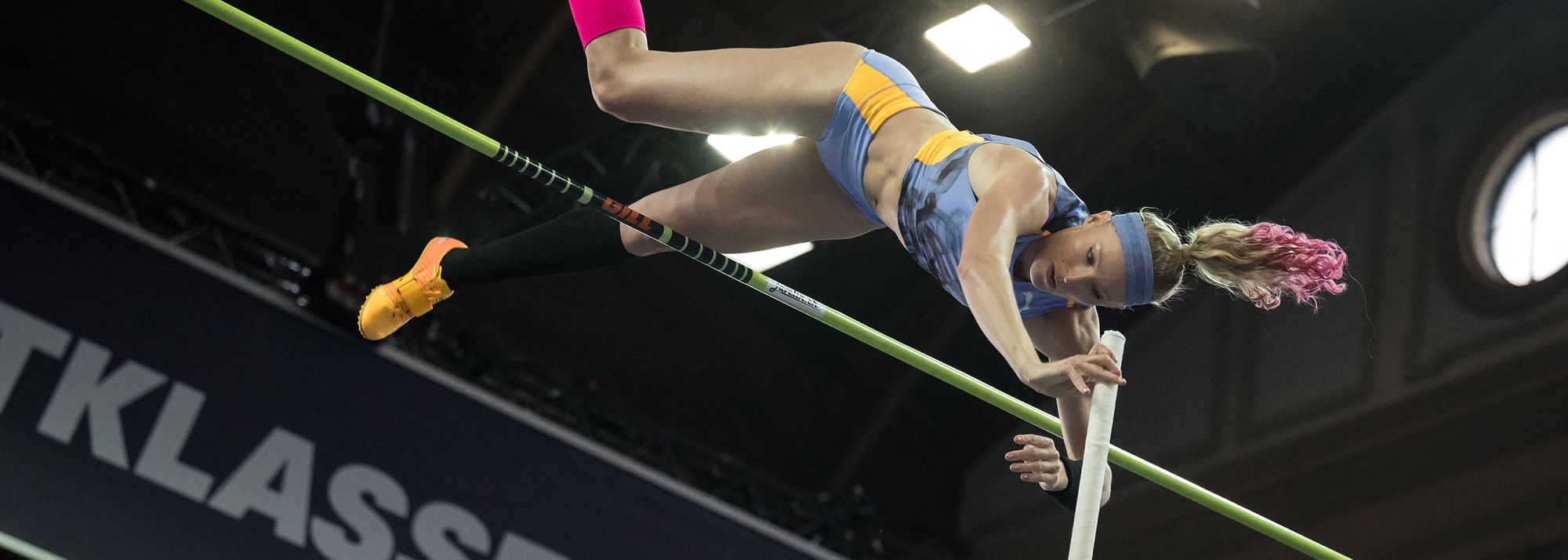
US pole vaulter Sandi Morris (© AFP / Getty Images)

As World Athletics reports, US pole vaulters Chris Nilsen and Sandi Morris started their year by securing victory at the National Pole Vault Summit in Reno, Nevada, on Friday (12).


Olympic and world medallist Nilsen cleared 5.90m to triumph ahead of his compatriot Zach Bradford and Thibaut Collet of France. In comparison, two-time world indoor champion Morris soared over 4.82m to prevail in a clash with her compatriot Katie Moon, the Olympic and two-time world champion.


Nilsen entered the competition at 5.45m and cleared that height plus 5.60m, 5.72m, and 5.82m on his first attempts. He needed all three tries to make it over his eventual winning height before passing at 5.96m and then attempting 6.01m.


Bradford and Collet managed a best of 5.82m to put them joint second ahead of Sam Kendricks, KC Lightfoot, Austin Miller, and Luke Winder, all with 5.72m.


In the women’s contest, at the start of a year that offers Morris the chance to defend her world indoor title in Glasgow in March and Moon the opportunity to defend her Olympic crown in Paris in August, both athletes entered at 4.43m. They cleared that height on the first try.


While Morris went on to clear 4.53m and 4.63m at the first time of asking, Moon needed two attempts to manage 4.53m and finished the competition joint second with Canada’s Anicka Newell when they both knocked the bar at 4.63m.


With the contest won, Morris then passed 4.73m and managed 4.75m on her second try before passing 4.80m and soaring clear at 4.82m on her third go.


Hana Moll, Katerina Stefanidi, Emily Grove, and Gabriela Leon finished joint fourth on 4.43m.


Results


Season openers in Baton Rouge and Fayetteville


North American 60m record-holder Aleia Hobbs opened her season by running 7.12 in the heats and 7.11 in the final at the LSU Purple Tiger meeting in Baton Rouge on Friday (12).


The Olympic 4x100m medallist set her area record of 6.94 when winning the US title last February.


World indoor silver medallist Mikiah Brisco was second behind Hobbs in Baton Rouge, clocking 7.24 after a 7.30 heat win.


Alia Armstrong won the women’s 60m hurdles in 8.05 after 8.10 in the heats, while Myles Thomas clocked 6.65 in the men’s 60m heats before running 6.61 to win the final.


Results


Also on Friday, USA’s 18-year-old Shawnti Jackson opened her season with a 400m win at the Arkansas Invitational in Fayetteville.


The world U20 100m bronze medallist claimed a clear victory in a PB of 52.10.


Shafiqua Maloney of Saint Vincent and the Grenadines won the women’s 800m and 1000m, running 2:02.70 to take the 800m ahead of Raevyn Rogers and 2:41.22 to improve her national record in the 1000m.


Britain’s Cindy Sember won the women’s 60m hurdles final in 8.06. In comparison, 2021 world U20 100m hurdles champion Ackera Nugent won the women’s 60m in 7.35, and Sanu Jallow dominated the women’s 600m to win in 1:26.52.


Over at the Rod McCravy Memorial in Louisville, world indoor silver medallist Devynne Charlton of The Bahamas dipped under eight seconds to win her 60m hurdles heat in 7.99.


Yusuf Bizimana set a US collegiate record to win the 1000m, clocking 2:18.10.


Eagles vow to overcome rumbling ‘Thunder’

In Nigeria’s Cup of Nations opener against Equatorial Guinea


By Rasheed Adewuyi


Nigeria and Equatorial Guinea are set to conclude the first matches of Group A of the 34th Africa Cup of Nations in Cote d’Ivoire when both nations clash at the brand-new Stade Alassane Ouattare in Ebimpe, outside Abidjan, on Sunday.


Matches between both nations have been few and far between, but Nigerians continue to relish a double over the neighbours to the south in qualification matches for the 2010 FIFA World Cup finals, when Joseph Yobo scored the only goal of the encounter in Malabo, and the Eagles then soared to a 4-0 win at the MKO Abiola National Stadium in Abuja.


On Saturday, Nigeria captain Ahmed Musa told thenff.com after the pre-match press conference that the Super Eagles have their eyes on the three points and have no apologies for their aspiration.


“It is always interesting to play in the Africa Cup of Nations. I was a champion in 2013, same as (defender Kenneth) Omeruo. However, the rest of the team want to have the feeling of what it means to win the Africa Cup of Nations. Everyone is geared towards making a statement.


“It will not be a picnic. All the teams in Group A are strong and ambitious as well. It is for us to go all out for the three points in each of our games, and then take it from there in the knock-out rounds. We will take it one match at a time.”


Nigeria’s campaign is woven around the aphoristic ‘Let’s Do It Again’ mantra, which was launched moments after their qualification for the finals, and is designed to galvanise and motivate the group to repeat the triumphs of 1980, 1994 and 2013, and also mobilise football-passionate Nigerians to support and encourage the group to action.


This year’s final tournament is Nigeria’s 20th appearance, having made her debut in 1963, and then appeared at the 1976, 1978, 1980, 1982, 1984, 1988, 1990, 1992, 1994, 2000, 2002, 2004, 2006, 2008, 2010, 2013, 2019 and 2021 finals.


The competition is also holding in the country where Nigeria reached the Final on away ground for the first time, losing to an experienced and battle-hardened Indomitable Lions of Cameroon at the Stade Felix Houphouet-Boigny in the Ivorian capital.


Nigeria remains the country with the most podium appearances at the Africa Cup of Nations, having in addition to wins in 1980, 1994 and 2013, finished as runners-up in 1984, 1988, 1990 and 2000, and picked up the bronze medals in 1976, 1978, 1992, 2002, 2004, 2006, 2010 and 2019, making for a total of 15 podium appearances in 20 finals.


Commentators continue to fret about a contention of lack of steel in midfield and perceived weakness in sectors of the defence, but Coach José Peseiro was bullish at the pre-match press conference on Saturday.


“I believe in my team. Every team has what you may call frail areas, but the important thing is for the players to play for one another. We are positive.”


Afterwards, he told thenff.com: “It is a 90-minute affair and it is always about who wants a win most. I have a group that has determination and discipline, flair and steel, and we believe we can go all the way in this tournament.”


Equatorial Guinea’s senior national team is known as the Nzelang Nacionl which means the ‘National Thunder’, but Musa said the Super Eagles will fly above any thunder strikes or claps the neighbours-to-the-East may be planning for Sunday.


“We are ready. This is a group of players love to compete, and we will give Sunday’s match, and the other games, our very best.”


Super Cup to end in another ‘El Clasico’

0

Barcelona to face Real Madrid


Barcelona to face Real Madrid in Super Cup final


Robert Lewandowski and Lamine Yamal scored second-half goals to give Barcelona a 2-0 win over Osasuna in a dour Spanish Super Cup semifinal in Saudi Arabia on Thursday.


Barca set up a dream show­piece clash on Sunday with Real Madrid, who had beaten city rivals Atletico Madrid in a breathtaking 5-3 derby ear­lier in the week. It will be a rematch from last year’s final, which Barca won 3-1. Barce­lona dominated possession in a dismal first half but were be­reft of ideas and barely threat­ened their opponents.


Lewandowski could have done better in a few half-chances, which a confident Osasuna goalkeeper, Sergio Herrera, denied. Still, it was not until the 59th minute that Bar­ca came to life and managed to break the deadlock. Ilkay Gun­dogan picked out Lewandowski with a through-ball, and the striker scored from close range.


However, Osasuna players were fuming and complained to the referee that Barcelona defender Andreas Christensen had fouled Jose Arnaiz before starting the counter-attack. However, a VAR check confirmed the goal. “We felt we were wronged because the refer­eeing criteria were very different during the match. The foul was clear,” Osasuna manager Jag­oba Arrasate told Movistar Plus.


After Lewandowski’s goal, Xavi brought Joao Felix off the bench. The Portuguese forward added impetus Barca seemed to lack up-front, forcing goalkeeper Herrera to make a couple of fine saves to keep Osasuna alive. Joao Felix created a quick counter and assisted Yamal, who blasted low into the net to secure the win and set up an El Clasico in the final.

.

Egyptian Arbiter to blastoff AFCON 2023

Amin Mohamed Omar to officiate opening match


Twenty-four hours before the kick-off of the 34th edition of the CAF Africa Cup of Nations.


TotalEnergies, Côte d’Ivoire 2023, Egypt’s Amin Mohamed Omar has been chosen to referee the match between the host country and Guinea-Bissau.


The 39-year-old is not at his first international experience; he officiated during the FIFA™ U-17 World Cup in Brazil in 2019.


His Compatriots, Mahmoud Ahmed Kamel and Ahmed Hossam Taha will support the Egyptians. Mahmoud Elbana was also appointed as the VAR referee of the match.


The match between Cote d’Ivoire and Guinea Bissau will kick off at 20:00 GMT at the Alassane Ouattara Olympic Stadium in Ebimpé.

.

South Africa defender warns all contenders

Continental experience will be essential for us – Khuliso Mudau


South African national team defender Khuliso Mudau believes the experience of key players on the continent will be helpful when Bafana Bafana attempts to relive their 1996 success of the TotalEnergies CAF Africa Cup of Nations.


South Africa touched down in Korhogo on Thursday, 11 January, where they will be based for their Group E fixtures set to take place at the newly built Stade Amadou Gon Coulibaly – the same venue that Mamelodi Sundowns Ladies from South Africa recently lifted the CAF Women’s Champions League.


Speaking to CAFOnline from the team’s base on Friday, the Sundowns defender, who recently lifted the African Football League title with his club, says experience on the continent will be vital for the team to succeed at the continental showpiece.


“It won’t be an easy group to get out of, but I think we have quality in the squad with players who are young and hungry. We want to make sure that we write history together. It will greatly help us have players playing in the Champions League. You can’t compare it with the local league because the intensity is different. So I think it’s going to help us a lot. We have been playing together for quite a while now as a team, and I am just grateful to be here and want to showcase my talent”, said Mudau.


In addition to Mudau and his Sundowns teammates, Bafana Bafana has the in-form Percy Tau, who not only has continental experience but recently came back with a bronze medal from the FIFA Club World Cup with Egyptian giants Al Ahly.


The team is also led by former TotalEnergies CAF AFCON winner Hugo Broos, who guided Cameroon to the title in 2017.


“He is critical. He is an excellent coach. An experienced coach and I believe if we can apply exactly what he wants us to apply, we can make it,” concluded Mudau.


South Africa is drawn with North African giants Tunisia and neighbors Namibia and Mali, who are expected to enjoy the most support with their nation being on the border of Korhogo.


CAF unveils star-studded line-up of Legends

0

For TotalEnergies CAF Africa Cup of Nations Cote d’Ivoire 2023


CAF has confirmed a star-studded lineup of African football legends for the TotalEnergies CAF Africa Cup of Nations Cote d’Ivoire 2023 to promote the tournament and enhance the brand awareness of the flagship continental sporting event.


The CAF Legends, comprising iconic former players, were selected based on their popularity, participation in major competitions, and social influence.


Each Participating Member Association (PMA) is represented by one of their famous players who has a rich history in continental football, except hosts Cote d’Ivoire with two. They will be attached to their teams and involved in social activations around the tournament.


Flying high, the colors of ‘Les Elephants’ of Cote d’Ivoire are the former captain and two-time CAF Player of the Year, Didier Drogba, and former offensive midfielder Salomon Kalou. Kalou was part of the Cote d’Ivoire that won their last TotalEnergies  Africa Cup of Nations in 2015.


Holders Senegal will find comfort in former captain Mamadou Niang, who led the Teranga Lions at the 2012 TotalEnergies Africa Cup of Nations in Gabon & Equatorial Guinea. He was also present in 2004, 2006, and 2008.


Other eye-catching African legends set to join their teams include Egypt’s Ahmed Hassan, four-time winner of the TotalEnergies Africa Cup of Nations – 1998, 2006, 2008, and 2010.


Also on the list is Nigerian midfield generalissimo Augustine ‘Jay-Jay’ Okocha, who won the continental trophy in 1994, and former Zambia captain Christopher Katongo. The latter guided the Chipolopolo to continental glory in 2012.


Siphiwe Tshabalala, the first player to score in Africa’s first-ever FIFA World Cup in 2010, represents South Africa, just as former Black Stars captain Stephen Appiah, who represented Ghana at all age groups.


TotalEnergies CAF Legends

Karim Ziani (Algeria)

Fabrice Alcebiades Maieco “Akwa” (Angola)

Moumouni Dagano (Burkina Faso)

Heldon Ramos (Cape Verde)

Joel Epalle (Cameroon)

Didier Drogba (Cote d’Ivoire)

Salomon Kalou (Cote d’Ivoire)

Shabani Nonda (DR Congo)

Ahmed Hassan (Egypt)

Rodolfo Bodipo (Equatorial Guinea)

Pa Modou Jagne (Gambia)

Stephen Appiah (Ghana)

Pascal Feindouno (Guinea)

Bocundji Ca (Guinea-Bissau)

Adama Tamboura (Mali)

Souleimane Brahim (Mauritania)

Manuel Jose Luis Bucuane “Tico Tico” (Mozambique)

Nourredddine Naybet (Morocco)

Ronald Ketjijere (Namibia)

Augustine “Jay-Jay” Okocha (Nigeria)

Siphiwe Tshabalala (South Africa)

Mrisho Ngassa (Tanzania)

Karim Haggui (Tunisia)

Christopher Katongo (Zambia)


Diversity dominate TotalEnergies AFCON squads

French Ligue 1 and Premier League rule


Excitement is buzzing around the continent as the biggest gathering of African football’s powerhouses occurs at the TotalEnergies CAF Africa Cup of Nations Côte d’Ivoire 2023.


Players plying their trade across the top leagues in Europe, Africa, and Asia will fight for national pride and bragging rights.


In this article by CAFOnline, we look at the diversity of the squads for the 24 qualified countries.


Six hundred twenty-eight players will represent the 24 qualified countries in the TotalEnergies CAF AFCON.


The French Ligue 1 dominates with 61 players playing in the topflight. PSG defender Achraf Hakimi and Ghana captain Andre Ayew, who plays for Le Havre.


Led by Mohammed Salah, thirty-one players are joining from the Premier League, and it could have been more if not for injuries to Thomas Partey and Wilfred Ndidi, among others.


The Saudi Pro League clubs have made the list due to the recent departure of some of the continent’s top talents from Europe to Saudi Arabia. There are twenty-five, including Sadio Mane, Riyad Mahrez, and Kalidou Koulibally.


Spain and Germany are also well represented at the TotalEnergies CAF AFCON. The La Liga has 22 while the Bundesliga has 17.


Reigning African footballer of the year, Victor Osimhen lead a tall list of Italian Serie A players to the tournament.  A little over 15 players from Italy’s topflight are in Côte d’Ivoire for the TotalEnergies CAF AFCON.


The TotalEnergies CAF AFCON has found a treasure trove of talents in Africa’s domestic leagues. Mamelodi Sundowns, Al Ahly and Orlando Pirates dominate the list. The three clubs combined contributed 30 players, thanks to the qualification of South Africa and Egypt.


Simba SC, Young Africans, FC  Nouadhibou, and Angola’s Atlético Petróleos de Luanda also share the overall talent representation at the TotalEnergies CAF AFCON.


‘The easiest race in my whole life’

0

Toth donates 2015 World Championships singlet to MOWA


Matej Toth wins the 50km race walk at the World Championships in Beijing (© Getty Images)

As Simon Turnbull narrates in World Athletics Heritage, after 31km of the punishing 50km race walk at the 2015 World Championships in Beijing, the race leader could resist no longer. Matej Toth had to temporarily step off the one-kilometer loop course to answer a pressing call of nature.


A lesser soul might have wilted under the pressure. Not Toth.


Quite the opposite, in fact. For the 32-year-old Slovakian, the unscheduled pit-stop simply relieved the mounting physical pressure.


He quickly regained the momentum that had taken him comfortably clear of a loaded field and proceeded to pick up his pace – to such an extent that he finished with a cushion of one minute and 45 seconds.


Eight years on, Toth has generously donated the Slovak singlet and name bib from the day he made World Championships history to the Museum of World Athletics (MOWA).


“It seems strange, but I have to say that this 50km was maybe the easiest race in my whole life,” said Toth, whose dominant victory earned his country their first World Championships gold medal. “I lost maybe 25 seconds with the pit stop but it helped me. It enabled me to get more control.


“I want to keep the feeling of winning here in Beijing. I want to keep the memory of entering this beautiful stadium forever. I just hope I will get to enjoy such a special moment at least once more in my life.”


Toth got his wish at the Rio Olympics 12 months later but Beijing was a big breakthrough victory for him at the age of 32.


It came on the back of a major advancement in March that same year in the annual Dudinska 50, the 50km race walk held in the southern Slovakian spa town of Dudince, part of the World Race Walking Challenge series.


Toth had won the World Race Walking Cup 50km title in Chihuahua, Mexico, in 2010, but it took him a further four years to gain his first major championship medal. That was a 50km silver at the 2014 European Championships in Zurich, with a time of 3:36:21 – behind the world record 3:32:33 set by Frenchman Yohann Diniz.


In Dudince the following March, Toth threatened to break Diniz’ global mark – being four seconds up at 20km (1:26:51) and level at 30km (2:09:20) – before finishing in 3:34:38. That put him third on the world all-time list, behind Diniz and Russia’s Denis Nizhegorodov (3:34:14).


Buoyed by confidence from such a stunning performance on home ground, Toth attacked from virtually the start at the World Championships in Beijing, leading for more than 49km.


At 5km, he led by eight seconds from Brazil’s Mario Jose Dos Santos Jr. At 10km, he was 27 seconds clear, with Ireland’s Rob Heffernan, the 2013 champion, in second place.


The gap grew to 55 seconds at halfway, which the Slovakian reached in 1:51:17. Despite his urgent ‘comfort break’, he covered the second half in 1:49:15, gaining a further 50 seconds on the field.


Toth flew across the line in the Bird’s Nest Stadium in 3:40:32. Australia’s Jared Tallent was a distant runner-up in 3:42:17, with Japan’s Takayuki Tanii claiming bronze in 3:42.55.


For Toth, six months past his 32rd birthday, it was the culmination of more than two decades of race walking graft.


Matej Toth in the 50km race walk at the IAAF World Championships, Beijing 2015Matej Toth in the 50km race walk at the IAAF World Championships, Beijing 2015 (© Getty Images)

Young talent


Growing up in Nitra, he tried hurdling and endurance running before getting bitten by the race walk bug. After three months of training under the guidance of Peter Meciar, a local race walking coach and journalist, Toth entered a 2km race in the town of Surany.


“I won in a time of about 10:20,” Toth recalled. “Two days before that race, my parents had bought me new shoes. I’m sure that motivated me to walk that little bit faster.”


By the age of 14, Toth was fast enough to make the international grade. He finished third in the U18 race at the World Race Walking Cup in Podebrady in the Czech Republic in May 1997.


“I remember it was very exciting to the see elite athletes producing top performances,” he said. “It was very motivational.”


Eighth in the 10km race walk at the World U20 Championships in Bydgoszcz in 1999 and 16th at the World U20 Championships in Kingston in 2002, Toth made steady progress after making the step up to senior international level at the 20km distance.


He was 32nd at the Athens Olympics in 2004, 21st at the 2005 World Championships in Helsinki and 14th at the 2007 World Championships in Osaka, before slipping back to 26th at the Beijing Olympics in 2008.


Change to 50km – ‘great motivation for the future’


“That was the first major disappointment on my career,” said Toth, referring to his second Olympic experience. “I prepared very hard and expected a top-10 finish but ended up 26th.


“I asked myself some hard questions after the race and wondered if it was time to retire. However, after a discussion with my coach, we decided to change my event from the 20km to the 50km.


“This provided a great motivation for the future and I was determined to prove I could compete with the top race walkers. I trained hard, enjoyed a great winter’s preparation, and in the first 50km race I completed, I set a national record.”


Matej Toth smashes the 50km course record in DudinceMatej Toth smashes the 50km course record in Dudince (© Jan Viazanicka / SITA)

Under the direction of coach Matej Spisiak in Basnka Bytrica, Toth emerged as a major force at 50km in March 2009, clocking 3:41:32 in Dudince. Five months later, he finished ninth at the distance at the World Championships in Berlin, also placing eighth at 20km.


Then, in 2010, came victory over 50km at the World Race Walking Cup in Chihuahua. “That was my first big medal,” Toth reflected. “It was a big surprise, not only for my opponents but also for me.


“It was great to stand on the highest podium and sing the Slovak national anthem. That was the day I realised I could win other major events – one day possibly Olympic gold.”


Rio 2016 – ‘only in the last 500m that I knew I would win’


Fifth at the London Olympics in 2012, and at the 2013 World Championships in Moscow, Toth proceeded to follow up his golden breakthrough at the 2015 World Championships in Beijing with Olympic 50km success in Rio de Janeiro in 2016.


Matej Toth in the 50km race walk at the Rio 2016 Olympic GamesMatej Toth in the 50km race walk at the Rio 2016 Olympic Games (© Getty Images)

In scorching hot conditions, the Slovak kept his cool as Diniz set off at a punishing pace. At halfway the Frenchman was almost two minutes clear but Toth kept his powder dry, eventually overhauling Australia’s Jared Tallent with 2km remaining to claim his country’s first ever Olympic gold in an athletics event.


“It was one of the hardest races of my career,” said Toth. “The weather was even worse than in Beijing. It was only in the last 500m that I knew I would win.”


Toth could not quite replicate his Midas touch at continental level, taking a second silver medal at the 2018 European Championships in Berlin in 2018.


After injury and the Covid lockdown, he mustered himself for one final shot at international glory at the delayed Olympic Games in Tokyo in 2021.


At the age of 38, Toth finished 14th in the 50km race in Sapporo – a battling finale for the great Slovakian foot-soldier of race walking.